Category: Uncategorized

  • Website Investing: How to Recover Traffic

    Early in 2025 I purchased a website that provided a service to the Mexican market. Its revenue model was to allow the user to perform a certain task easily, then charge them for the end result (~$2 fee).

    The site was created in 2021 and in the past had generated $28,000 of revenue annually, most of which was profit. When I acquired it, it was on a steep decline in the search rankings, only making $3,600 annually and eventually hit a floor of around $1,200 revenue. I paid $5,000 for the site (with some other sites thrown in to sweeten the deal). For those interested I paid around 3x the annual revenue of all the sites I acquired.

    To recover rankings I decided to focus on one thing and one thing only – back links. For this I used a good but expensive provider. My goal was to spend $500 per month, netting between 3 and 5 backlinks pointing back to the site.

    Months 1 and 2

    In the first month there was zero change in site ranking. At the start of month 2 the rankings suddenly jumped from around position 9 or 10 to position 5 or 6. And how many extra site visitors do you think this resulted in?

    I was now receiving 4x the normal volume of Google Search clicks!

    Normally I would discount this jump as an anomaly. For example, perhaps some Mexican holiday had caused things to change BUT I have a control website.

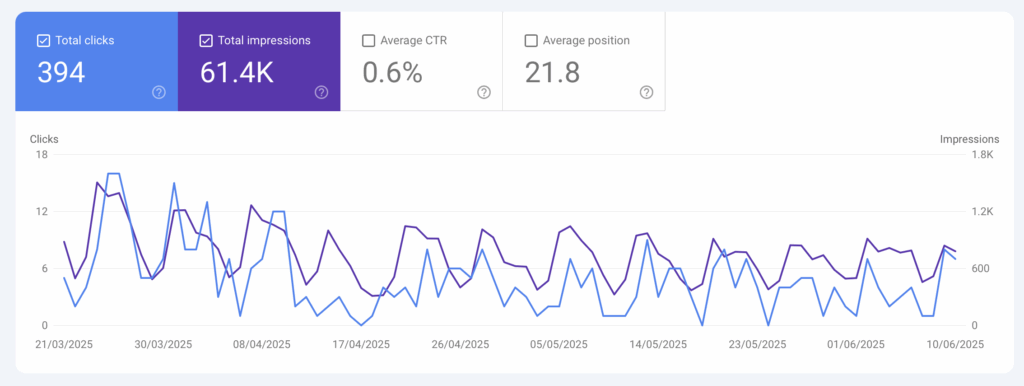
    As part of the original deal another site had been thrown into the mix that ranked for pretty much all the same keywords. That second sites traffic and rankings did not change one bit during this period. In fact they declined.

    Therefore I can almost conclusively say that back linking was the reason for the jump in ranking.
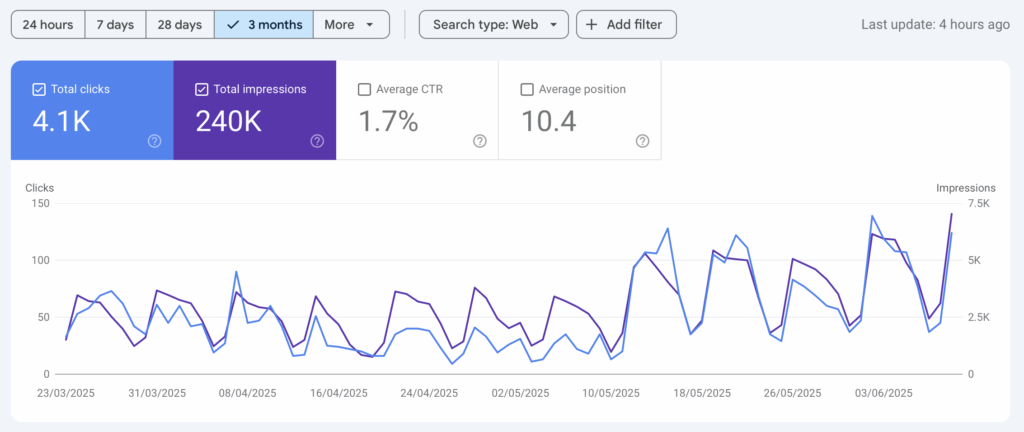
    Change in impressions and clicks for the Mexican website (with paid back linking). From 10th May incoming clicks quadrupled
    Similar site ranking for the same search terms (no back linking). Only a mild decline in impressions and clicks.

    Interestingly I had only acquired 3 backlinks during that first month. However they were from well regarded sites with a domain rating of between 20 – 30 (the maximum rating being 100). Just 3 links had quadrupled inbound clicks!

    More importantly a move of 4 positions up the ranking resulted in 4x the traffic. On average, position 10 receives 1.5% of search clicks but position 5 receives 5.1% so the 4x in traffic tallies well with that general statistic.

    So where do we go from here? Obviously, position 1 is the goal and I think that is achievable, as my industry is low competition. Position 1 receives 40% of all search traffic so that is another 8x from where the site is now. That alone would restore annual revenue to $28,000.

    How Much Profit Does this Make?

    Purchase price: $5,000 (including some other sites but we’ll leave those out of this calculation)
    Back link cost: $3,000 to $6,000 (the latter if I need a full year of backlink building, which I’ll assume as worst case scenario)
    Cost of my time: $2,000 (2 days total at software engineer consultancy rates)

    Total acquisition and investment expenses: $13,000

    There are 2 scenarios to calculate return on investment:

    Scenario 1 – Keep the Website as a Cash Flowing Asset

    Annual income of $28,000 less back link expenses ($3,000) = Annual Profit $25,000. Factor in the purchase investment @ $13,000 and the annual return is 192% on original outlay.

    Where else could you get 192% return on your investments? Nowhere!

    Scenario 2 – Sell the Website

    In this case I would keep the site for 2 years to show a good track record of profitability to the potential buyer. Calculations as follows:

    Total profit (same as scenario 1) = $25,000 x 2 = $50,000
    Less purchase cost: ($7,000)
    Website value @3x annual profit: $75,000
    Less sales commissions (10%): ($7,500)

    Total income for 2 days of my time: $110,500.

    Yes that’s a nice number but this experiment needs room to run to see if it’s achievable. However if I scale back my expectations from position number 1 the numbers would change as follows:

    Profit According as a Function of Search Rank

    When selecting a target for acquisition and improvement I think the most important metric is to asses where you think you can get to in the search results. For example position 1 may be untenable due to a very well linked competitor – but is position 2 possible? Or 3?

    With my Mexican site, if I maxed out at position 2 then I would net $55,000 in case of a sale. For position 3 that number drops to $28,000. Even with the latter that’s still an earning of $14,000 per day of my time. In many countries that’s a full time salary!

    How to Scale?

    When I bought this site I promised myself I would NOT be doing any writing, blogs and other time consuming things. It was to be a pure back linking experiment, with almost zero of my time invested. Therefore, if I will not expand into other content areas this sites scalability will be limited once I rank at #1 for my particular search terms.

    Thus I will sell the site once I get close to that ranking goal.

    I’m already looking at acquisition of another website but at 10x the size (~$50,000 purchase price). The key is for that site is that it’s in a similar position with plenty of ranking upside. The upside, all else being equal, is somewhere between $140,000 and $1.1 million per day of my time.

    Now that’s food for thought (although I suspect this process will be less scalable the further up the ladder I go).

    I’m holding off for now though as I want to run the Mexican experiment for at least another 4 months to see how it actually goes! Look out for updates here!

  • How to Find a CTO for Your Startup

    So you have an idea and you probably think that 50% of the hard work is done. Now you just need someone to build it and millions will roll through the front door. You, sir, are one of many “Ideas Founders“.

    Ideas Founders believe in their idea so much that they think success is a certainty.

    Well, it’s bubble bursting time – very few companies get to that point. In fact, of VC funded companies in 2023 a whole 90% went bust. Your chance of not failing, if funded, is 10%. I’d even wager that a portion of those 10% barely make enough money to pay back the investors.

    And what if you’re not funded? Well the odds drop another 10 fold so we’re looking at 1%.

    • Yes, I know your idea is amazing.
    • Yes, I know you have a spreadsheet.
    • Yes, I know you’ve paid to have a kick ass design made.

    Your odds of success are still less than 1 in 20. I know this because Venture Capital makes all its returns from unicorn companies, which are 1 in a thousand. You don’t see the 999 that didn’t make it.

    But YOU ARE A GENIUS and still not dissuaded. You will manifest this product into the marketplace.

    The Product Creation Process

    Every business product starts with an idea. Did you know that ideas are the most abundant mineral on Planet Earth? Literally millions appear in peoples heads on a daily basis.

    However, your idea is unique, well researched and validated.

    So now you need to build that idea. You need something that us techies call a Minimum Viable Product (MVP). Then you can go out, test it, get feedback and iterate. This might take 4 months if the stars align, but more like 6-18 months.

    With total abandon you scrawl 10 lines of “specification” onto a napkin and request quotes from dev shops. Very quickly, though, you realise it’s expensive. You’ll need to part with at least 50k (but trust me you’ll always end up paying double that to get what you want).

    Problem is, you don’t have 50k, or if you do, you don’t really want to part with it. (But you still 100% believe in your idea).

    Of course this is not a problem as you have valuable stock to give away, right? That’s why you try to flag down a programmer whom you shall name CTO, offering him a huge chunk of your valuable company, maybe even 40%.

    Now you need only sit back and wait for him to build your masterpiece, with the occasional checkup call to see how your brilliant investment is doing.

    Show Me the Money

    Whilst your resident geek has been toiling away in his basement you’ve been doing a lot of work. Modelling financial projections, thinking about investment rounds, valuations and more. In fact your spreadsheets are a work of art. They are so good that you could sell them to buy a mansion and Rolls Royce with plenty of change left over for a private island. You are a genius.

    Then, an alarm goes off. Time to check in on your enslaved programming basement dweller Chief Technical Officer.

    Progress is going really well and the app looks good so you order it to be published. 1 week later you check downloads and sales figures.

    No downloads. No sales. No nothing.

    Hmmm, the product must be faulty. Time to have a heart to heart with your CTO.

    Despite “motivating” your CTO (another skill from your infinite stack) the masses still have not arrived…and there is still ZERO revenue. What gives?

    The End of Your Company

    After another 6 months of iteration there is still no revenue and you’re bored. It must be the technology that sucks. Maybe you should have had the Geek use React.js instead of Angular. Anyway, never mind, you’ve just noticed that a local coffee shop is doing amazingly well so you dream up a coffee subscription app that they could pay you for.

    This shiny new thing is what will get you that yacht.

    That old idea from a year ago simply didn’t have the right tech stack or CTO and that’s why it failed. Coffee is the new money maker in town.

    You gleefully part ways with that awful CTO and immediately begin interviewing for another one. This new one must be passionate about coffee, subscriptions and business processes. This time, it’s different.

    Why you Failed

    I hope that my sarcasm was strong enough for you to realise one thing:

    Sales is everything.

    No matter how good your CTO and product you must still put it in front of people and push for a sale. No sales means no revenue means no company.

    You may say this is obvious but many “Idea Founders” don’t realise it, wasting inordinate amounts of CTO time in return for stock that is worthless.

    Why You Won’t Get a CTO for Free

    The devils bargain is to hire a CTO for 40% of equity right? That way you get a competent employee for free, right?

    Actually, no.

    Any seasoned tech guy, be that lead dev or CTO is going to look at you very critically.

    • How many pre-sales do you have?
    • Did you create a no-code version of your app to see if the market wanted it?
    • Did you pay someone to create a basic MVP that you have signed letters of intent for?

    If the answer to these questions is no then he’s going to give you a hard pass. He wants to know what you bring to the table. And no, an idea is not worth anything.

    You may think that your offer of 40% equity will right this situation, and you’d be wrong. Let me show you why by asking a simple question:

    Where could I sell a quarter of my 40% stock, right now, to pay my bills?

    That’s right. Nowhere. Would you, the genius “Ideas Founder” even buy them? If my 40% is worth 400 million in the future then I’ll give you 10% now for a bargain price of 100 thousand! Let me guess, you won’t take that deal.

    AND YET, Ideas Founders expect us tech people to take worthless equity in return for a year of hard work building a product.

    Equity value is built, not dreamed into existence by your ideas.

    No-one serious is going to sign on to your company by the strength of your idea alone. 12 months of hard work in return for nothing – or I could build 25 of my own mini products on the web and float them to see what sticks. One of those could be worth 100k / year for 10 years. That’s a cool million in my pocket (for a few weeks of work).

    How does your 40% of nothing compare to that?

    Don’t believe me? Just have a look at Indie Hackers or Product Hunt to see all kinds of one man band success.

    So How do You Get a CTO?

    So far I have taken a big steaming dump on your dreams of getting a free engineer. Now let’s see how you can actually attract and keep one.

    1. An Engineer is not a Nerd, He is an Artist

    You may see Matrix code when you walk into an engineers office but he sees pure art. There’s something amazing about creating the perfect code that just gets us going. The ONLY way you get this out of someone is to not make them feel pressured.

    And can you guess how to get average output from an engineering rockstar?

    Easy. Simply treat him like an employee, one you don’t even pay. Order him around all the time and interrupt him continuously asking what he’s working on now.

    How far would Leonardo Da Vinci have gotten if his boss has been looking over his shoulder every 30 minutes?

    When you take on a CTO, he is your partner, and not your employee.

    Your CTO has a skillset that you do not possess so let him use it according to his best judgement. Never order him around. If you want something built then communicating that is fine (notice I said communicate and not order).

    Ultimately you’re taking him on to build the product and make sure it runs. Your technology views should be checked at his door or only brought up as though you were talking to your wife on Valentine’s day, and not your dog who won’t drop the ball.

    In short, he’s the f****** CTO so he decides technical things. Do not interfere and you’ll get the best from him.

    2. WTF do You Bring?

    Yes, you. And no an “idea” is not a thing. The 2 things you must bring are:

    1. Funding, or a solid route to funding (without sucking up CTO time before that)
    2. Sales ahead of time or gold star sales experience from your past

    If you only come with Option 1, then that is acceptable if you will pay for your CTO’s time, at least partially. If you also come with Option 2 then you are an A star candidate and CTO’s will throw themselves at you like you’re an A list celebrity.

    Personally I can count on one hand those I’ve met with Option 1 and am yet to meet someone who also has Option 2.

    You may look at this list and think you have neither but you’ll plough ahead anyway. Well, for that let me refer you to this Reddit thread (there are many more like it). Tech people are wise to your tricks. Offering us nothing for work doesn’t go so well when places like Facebook will pay you 150k starting salaries (plus stock).

    If you really believe in your idea then you can make an investor believe, and he will part with the cash you should pay the CTO to actually make your product.

    Who the F*** Are You to P*** on my Dreams?

    Hey, I get it. You’re angry reading this article. Your first reaction is to assassinate my character then I have no standing. So here’s my character for you:

    I’m just an average tech guy, building stuff I think will work. Every single day. Whatever I build I keep 100% equity in. I haven’t needed a job in 10 years, and probably never will. I’m not rich or poor but happy every single day because I love building – and I get to do it every day.

    Ps:

    If this article has offended you then please tell everyone on social media and link to it so they can be enraged too. All those free backlinks will sure teach me a lesson.

  • Technology Job Salaries by Year and Sector

    This post is the once stop shop for you to see tech, software engineering and IT salaries from around the world. Simply click any link below to see what you should be earning! These are updated every year so you can get an idea of the progression, and extra cash, that you should be seeing!

    2024 Salaries

    Software Engineering Salary by Country